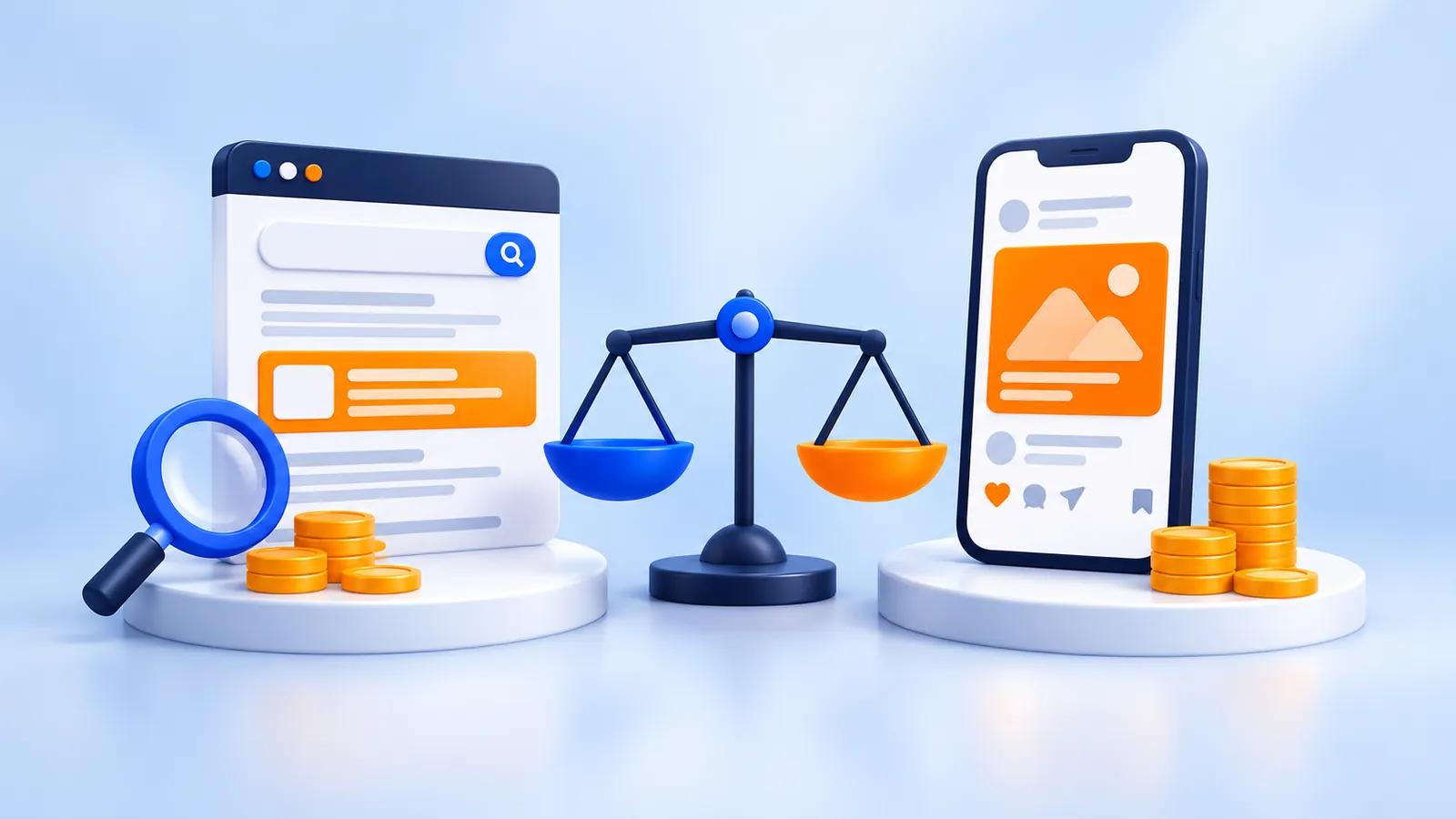

Start with Google Ads if people already search for what you sell and you need enquiries soon: it shows your business to people who are looking right now. Start with Facebook and Instagram ads (Meta) if your offer is visual, new or something people don't search for yet, and you can follow up leads quickly: Meta builds demand among people who fit your ideal customer. Once the budget allows, most of our clients end up running both, because the two platforms do different jobs.
This guide compares the two for a local or service business: how each one finds customers, what each costs, which to start with in your situation and industry, and how to split a budget when you run both. We run both platforms every day, so we have no channel to push.
The short answer: Google Ads vs Facebook Ads at a glance
| Google Ads (Search) | Facebook and Instagram ads (Meta) | |
|---|---|---|
| How people find you | They type a search ("emergency plumber Mississauga") and your ad appears | Your ad appears in their feed, Stories or Reels while they scroll |
| Intent | High: they're looking for the service now | Lower at first: they weren't looking, but they fit your audience |
| Best for | Services people already search for, urgent needs, high-value local services | Visual offers, new services, promotions, events, building a following |
| Typical lead quality | Usually higher, because the person asked for it | More mixed; improves with qualifying questions and fast follow-up |
| Creative needed | Mostly text: headlines, descriptions, a landing page | Images and short video, refreshed regularly |
| Time to first leads | Often within days of launch, if people search for your service | Usually within the first weeks; the first month is mostly testing |
| Minimum sensible ad spend (our guidance) | $500–$1,000/month | $500/month |
| Tracking | Calls, forms and bookings as conversions in Google Ads | Meta Pixel and Conversions API; leads may arrive inside Meta |
The rule underneath the table: Google captures demand that already exists; Meta creates demand that doesn't exist yet. Everything else follows from that.
How Google Ads works for a local business
Google Ads Search campaigns show your ad when someone searches for words you've chosen (keywords), in the areas you choose. You can target a whole province, a city or a radius around your address (Google Ads Help). With cost-per-click bidding, you pay for each click on your ad, not for the ad being shown (Google Ads Help).
For a local business, that means:
- You reach people at the moment of need. Someone searching "windshield replacement near me" or "lip filler Toronto" has already decided they want the service. Your job is to be the business they choose.
- Keywords decide everything. The right keywords bring buyers; broad or loose keywords bring people researching, job seekers and competitors. Negative keywords (searches you exclude) matter as much as the ones you add.
- Location targeting keeps spend local. A clinic in Etobicoke doesn't need to pay for clicks from Ottawa.
- The landing page closes the deal. The ad gets the click; a fast page with a clear call or booking button turns it into an enquiry.
Our managed Google Ads campaigns are built around those four points: tight keywords, local targeting, conversion tracking and landing pages that match the search.
How Facebook and Instagram ads work for a local business
Meta ads don't wait for a search. You choose an audience (an area, an age range, interests, or people who've already visited your website or engaged with your page), and Meta shows your ad to the people in that audience it predicts are most likely to respond. Meta's auction doesn't simply pick the highest bid: it weighs your objective, budget, audience and creative to decide which ad to show (Meta, About the ad auction).
For a local business, that means:
- Creative does the targeting. The image or video decides who stops scrolling. A gym's 15-second clip of a real class does more than any audience setting.
- Lead forms make it easy to enquire. Meta's lead ads let people send their details without leaving Facebook or Instagram (Meta, Lead ads). That's convenient, but these leads need a call or text within minutes, or they go cold.
- Retargeting keeps you in front of warm prospects. People who visited your site or watched your video can see a second, different message while they decide.
- It builds over time. The first weeks are for testing audiences and creative; results usually improve as the campaign learns.
Our Facebook and Instagram ads management covers the strategy, creative, audiences, Pixel and Conversions API setup, and the testing.
Cost: what each platform costs to run
Both platforms have the same two costs: ad spend, which you pay to Google or Meta, and management, which you pay to whoever runs the campaigns (or your own time if you do it yourself).
| Google Ads | Meta Ads | |
|---|---|---|
| What you're charged for | Mostly clicks (cost per click) | Depends on the campaign; budgets are set daily or for the campaign's lifetime |
| Our recommended minimum ad spend | $500–$1,000/month | $500/month |
| Our management plans | $750, $1,250 or $2,000/month | $750, $1,250 or $2,000/month |
| What changes the cost most | Competition on your keywords, industry, location | Audience size, objective, creative quality, time of year |
Meta's pricing page explains that the campaign objective, audience size and placements all affect cost, and that on a daily budget Meta can spend up to 75% more than the daily amount on a given day, while keeping the week's spend to no more than seven times the daily budget (Meta, Ads pricing).
Cost per click vs cost per lead. Facebook clicks are often cheaper than Google clicks, but that comparison misleads. What matters is cost per lead (CPL: ad spend divided by enquiries) and, better still, cost per booked customer. A cheap click from someone who wasn't looking can cost more per customer than an expensive click from someone who was.
For the full breakdown, see what Google Ads management costs and what Facebook ads cost in Canada. To estimate a Google budget from the number of leads you want, try our Google Ads budget calculator.
Which to start with: a decision table
If you can only afford one platform right now, use this table. It's the advice we give on discovery calls.
| Your situation | Start with | Why |
|---|---|---|
| People already search for your service ("dentist near me", "furnace repair") | Google Ads | The demand exists; you just need to be found |
| Emergency or urgent service (towing, locksmith, auto glass, plumbing) | Google Ads | Nobody scrolls Instagram to find a locksmith at 11 p.m. |
| Visual offer or something people don't know to search for yet (a new treatment, a gym class format, a product) | Meta | You have to show it before anyone will search for it |
| Long decision cycle (cosmetic treatments, renovations, coaching) | Both, when budget allows; start with Google if people search for it, Meta if they don't | Google catches the ready buyers; Meta stays in front of people while they decide |
| Very small budget (under about $500/month in ad spend) | Google Ads, on your single most profitable service | Fewer, higher-intent clicks are easier to learn from than broad reach |
| Nobody can follow up leads within an hour | Google Ads, sending calls and bookings to you directly | Meta lead-form leads go cold fast without quick follow-up |
There are exceptions. If you already have a large Instagram following or an email list, Meta retargeting can be the cheapest place to start. If nobody in your area searches for your service at all, Google has nothing to show your ad against, and Meta is the only option of the two.
By industry
Med spas and aesthetic clinics. Treatments sell visually, and many clients decide over weeks, so Meta does a lot of the work. People also search for specific treatments ("anti-wrinkle injections Toronto", "lip filler near me"), so Google catches the ones ready to book. Most clinics we work with run both. See Google Ads for med spas and Facebook and Instagram ads for med spas for each side in detail.
Gyms and fitness studios. Meta usually leads. Fitness is visual and impulse-friendly, and a class or a transformation sells better on video than in a search ad. Alpha Gym, a private training gym, grew from 10 to 350 private clients in 2 months with Meta Ads and Instagram content, then kept growing about 25% a month. Read how Alpha Gym grew with Meta Ads.
Auto services and trades. Google usually leads. Nobody browses for a windshield until theirs cracks. For SRG Auto Glass we ran targeted Google search campaigns, later adding paid video and display ads, alongside SEO work on the website. The SEO work moved SRG from 7th to the top 3 in local search in three months; the paid search side brought in enquiries while the rankings climbed. See what we ran for SRG Auto Glass.
Ecommerce. Usually both from early on: Google for people searching for the product, Meta for discovery and retargeting people who viewed a product but didn't buy.
When to run both (and how to split the budget)
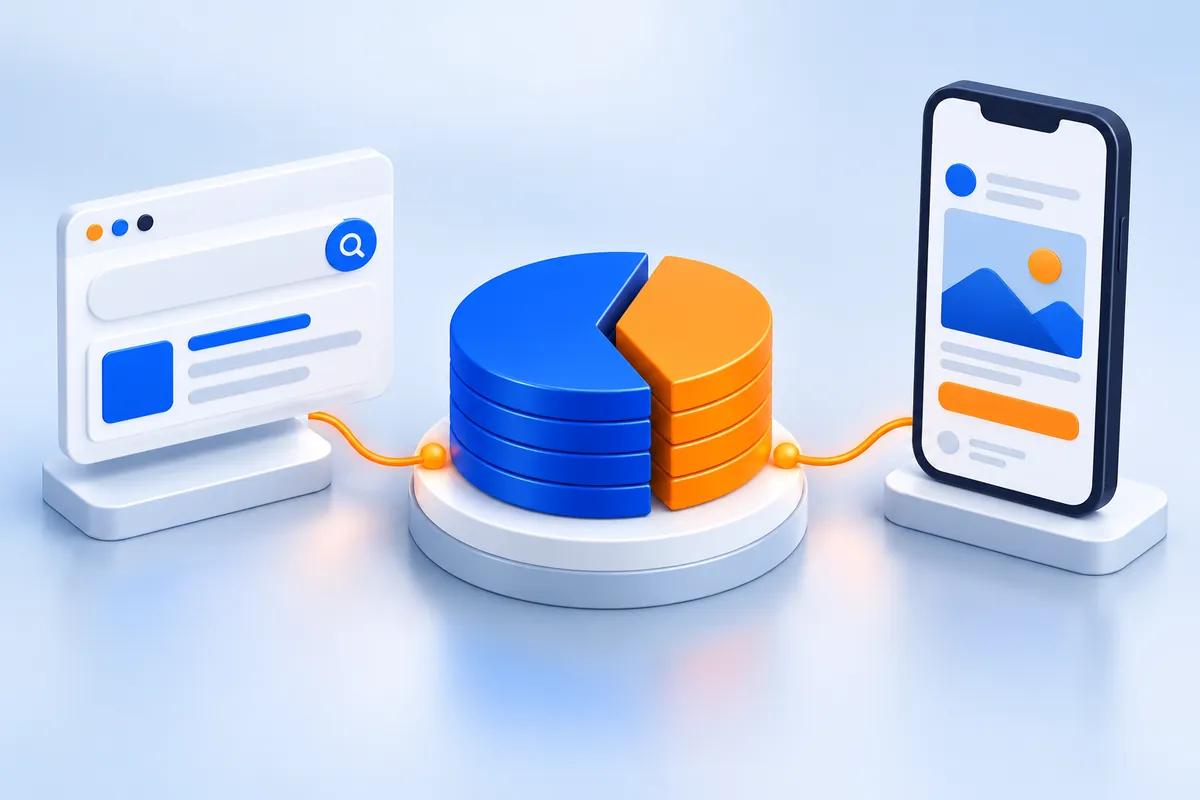
Running both makes sense once you have enough budget to give each platform its minimum (about $1,000–$1,500/month in ad spend in total) and someone to follow up the leads. The platforms then support each other:
- Google captures demand. It catches people searching for your service, including people who first saw you on Instagram and later searched your name or treatment.
- Meta creates demand and retargets. It introduces you to people who weren't looking, and follows up with people who visited your site from a Google ad but didn't book.
How we decide the split. We don't start from a fixed ratio. We start by giving Google enough budget to cover the searches for your main services in your area, because that's the demand closest to a booking. Whatever is left goes to Meta, with a small share reserved for retargeting. After the first month, budget moves toward whichever platform brings booked customers at the lower cost, and we check that against cost per booked customer, not cost per click.
Luna Aesthetics in Toronto is a good example of both platforms working together: Google and Meta ads alongside a new booking website, starting on $35/day across Google and Meta combined. The result was a 4.8× ROI in 90 days. Read the Luna Aesthetics case study. (ROI in our case studies is return on ad spend: revenue from new bookings attributed to our campaigns, divided by ad spend over the same period, Google and Meta combined.)
If you want to run Google and Meta together with your website and social media handled by one team, our All-in-One Growth Package covers both platforms for $1,499/month, cancel anytime.
Common mistakes
- Boosting posts instead of running campaigns. The "Boost" button is quick, but it gives you little control over the objective, audience and tracking. A proper campaign in Ads Manager lets you optimize for enquiries, not likes.
- No conversion tracking. Without tracking calls, forms and bookings, neither platform can learn who your customers are, and you can't compare the two. Set it up before you spend.
- Judging Meta by last-click results. Many people see a Meta ad, then search your name on Google a week later. If you only count the last click, Google gets the credit and Meta looks worse than it is. Compare total booked customers before and after, not just each platform's own report.
- Running Google on broad keywords without negatives. Loose keywords match searches you never meant to pay for. Review the search terms report weekly and exclude the irrelevant ones.
- Switching too early. Two weeks isn't enough to judge either platform. Give each one at least a month of clean data at a sensible budget.
FAQ
Is Facebook cheaper than Google Ads?
Per click, Facebook and Instagram are often cheaper. Per customer, not necessarily, because Google's clicks come from people already looking for your service. Compare cost per lead and cost per booked customer, not cost per click.
Can I run both with a small budget?
You can, but it usually spreads the budget too thin to learn anything. We recommend at least $500–$1,000/month for Google and $500/month for Meta. If your total ad budget is below about $1,000/month, pick one platform using the decision table above, prove it works, then add the second.
Which is better for leads vs brand awareness?
For leads from people ready to buy, Google Ads usually wins. For awareness, reaching new people and staying in front of them while they decide, Meta is stronger. Many local businesses need both: awareness today becomes searches next month.
Is Instagram different from Facebook ads?
They're the same system. Instagram ads are created in Meta's Ads Manager alongside Facebook ads, and one campaign can run on both. What differs is the audience and the format: Instagram leans younger and more visual, with Reels and Stories doing much of the work. We usually let a campaign run across both placements, then adjust based on where the bookings come from.
How long before I know which works?
Give each platform at least four to six weeks at a sensible budget, with conversion tracking in place. Google often shows enquiries within days if people search for your service; Meta usually needs its first month for testing creative and audiences before costs settle.
Next step
Not sure which platform fits your business? Book a call and we'll look at your services, area and budget and tell you where we'd start, even if that's only one platform.